From Four Walls to a Million Listeners: How Chaar Diwaari Turned Isolation, Experimentation and Restlessness Into His Own Language
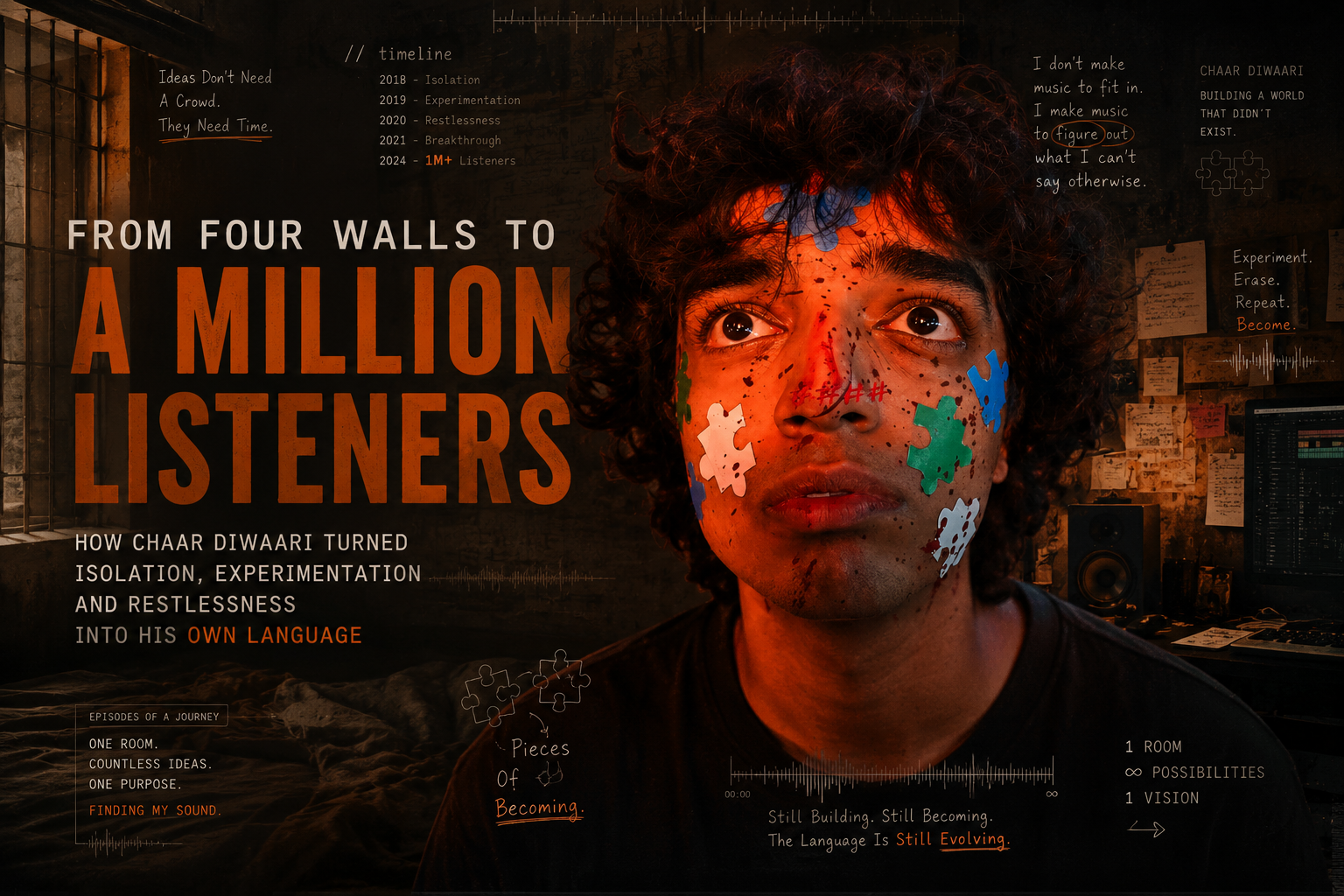
There is something fitting about an artist calling himself Chaar Diwaari.
The name, which literally translates to "four walls", came from something remarkably ordinary. As a teenager, Garv Taneja spent so much time locked inside his room making music that his mother would complain about him always being within those four walls. Years later, the phrase would become the identity of one of India's most unconventional young artists.
But the irony is hard to miss.
The four walls that once represented isolation eventually became the foundation of an entire artistic world.
Today, Chaar Diwaari is difficult to place inside a single category. He is a rapper, singer-songwriter, producer, visual artist, director and editor, often handling multiple stages of his own work. His music has moved through experimental hip-hop, electronic music, Indian influences, psychedelic textures, pop and darker forms of rap without settling permanently anywhere. His videos are not simply promotional companions to his songs either. They are part of the same world.
That refusal to remain in one place is perhaps the most consistent thing about him.
Before the millions of streams, Def Jam India releases and collaborations with artists such as Raftaar, Encore ABJ, Indian Ocean and Sonu Nigam, Garv was simply a teenager trying to figure out how music worked.
He did not come from the conventional image of a young musician.
There was no childhood filled with formal instrumental training or a carefully planned musical education. In fact, Garv has spoken about not playing instruments as a child and having no formal musical training during his early years.
What he did have was curiosity.
At around 13, he got his hands on a pirated copy of FL Studio and began experimenting. One of his earliest serious attempts at production was recreating the beat of "Proper Patola" by Badshah and Diljit Dosanjh. At around 14, Bohemia and a school assignment involving Hindi poetry pushed him further toward writing his own rap.
The interesting part is that he wasn't necessarily thinking about becoming a rapper in the traditional sense.
He simply wanted to make things.
If rapping didn't work, he had already considered other possibilities: becoming a producer, a DJ or even making advertising jingles. The underlying ambition wasn't fame. It was finding a way to remain close to music.
That instinct would become important later.
Because Chaar Diwaari's career has never really been about mastering one role.
It has been about removing the distance between the idea and the finished piece.
Garv eventually attended True School of Music in Karjat, Maharashtra, from 2020 to 2023. On paper, it was the obvious next step for someone serious about music. In reality, his relationship with the institution was complicated. He has described the experience as simultaneously one of the most important and most useless things he had done.
The contradiction makes sense when you understand what actually changed during those years.
It wasn't necessarily the formal education.
It was the isolation.
For three years, he had the time and space to obsess over music. He could experiment without constantly worrying about what was commercially correct or immediately understandable. He could fail repeatedly.
And he did.
At one point, despite having been producing music almost every day since he was 13, Garv hadn't even finished a complete song.
Finishing one became a goal in itself.
Eventually, he did.
Then another.
Then another.
That simple shift from endlessly experimenting to actually completing music became one of the most important developments in his artistic journey.
It also explains something about the Chaar Diwaari catalogue that can otherwise be mistaken for chaos.
The music often sounds like it is deliberately breaking rules.
But the person making it spent years learning exactly how those rules worked.
His influences were never limited to hip-hop either. Before experimental rap became his identity, there was Bollywood.
R.D. Burman, O.P. Nayyar, A.R. Rahman, Vishal-Shekhar and Sajid-Wajid were among the figures who shaped his musical imagination. He has spoken about R.D. Burman almost reverentially, describing him as a teacher despite never having studied under him.
Then came another crucial influence: the early Indian hip-hop and desi pop ecosystem.
Yo Yo Honey Singh and the Mafia Mundeer era showed him something that went beyond sound. There was a sense that music could be made outside traditional structures, distributed differently and built around an identity that was recognisably Indian while still drawing from global influences.
That combination eventually became central to Chaar Diwaari.
His debut EP, Teri Maiyat Ke Gaane, arrived in 2022 and introduced an artist who didn't seem particularly interested in making himself easy to categorise.
The project was born out of a much darker emotional period. Rage, loneliness, frustration, alienation and resentment found their way into the music. Rather than smoothing those emotions into something commercially digestible, Garv allowed them to remain abrasive.
The result wasn't polished in the conventional sense.
It was expressive.
And that distinction matters.
Because Chaar Diwaari's music has repeatedly emerged from a refusal to separate art from whatever is actually happening inside him.
"Jhaag" explored alcoholism and self-destruction. "Bhool Ja" dealt with escapism. "Kaun Mera?" questioned identity and belonging. "Farebi" confronted imposter syndrome. "Barood" leaned into darker emotional territory.
On the surface, these songs can appear abstract, eccentric or deliberately difficult.
But beneath that is something much simpler.
They are personal.
Garv has spoken about finding it difficult to write something he doesn't genuinely feel. The unusual production, fragmented structures and unconventional visuals aren't necessarily attempts to conceal meaning. They are often his way of translating experiences that don't naturally fit into straightforward songwriting.
That philosophy also explains why he has resisted the pressure to develop a single, instantly recognisable "Chaar Diwaari sound."
For most artists, sonic consistency is treated as a virtue.
For Garv, it can become a limitation.
His view is that a person changes constantly, and therefore their art should be allowed to change too. He has questioned the idea of chasing a fixed sound simply because the industry expects an artist to become recognisable.
The result is a catalogue that refuses to behave predictably.
One song may feel like experimental hip-hop. Another may lean toward electronic music. Another may draw from Indian melodic traditions. Another may feel almost psychedelic.
The inconsistency is the consistency.
He is not trying to sound like Chaar Diwaari.
He is trying to sound like himself at whatever point in his life the song was created.
That approach became even more apparent when he abandoned an entire project, Duniya aur Diwaari, after feeling that he had evolved beyond the music.
There is something unusually confident about throwing away completed work.
Especially when you're still building a career.
Most emerging artists are terrified of wasting material. Every finished song becomes something they feel obligated to release. Garv's decision suggested a different priority: the work had to represent where he was going, not merely prove how much work he had already done.
That evolution eventually led into a much larger stage of his career.
Releases such as "Jhaag", "Roshni", "Thehra", "LOVESEXDHOKA!!!", "Farebi" and "Banda Kaam Ka" expanded his audience, while his visual identity became almost inseparable from his music.
The numbers followed.
His catalogue now sits at a scale that is difficult to reconcile with the underground label often attached to him. Spotify has placed him around the 1.5-million monthly-listener mark, while individual tracks have accumulated millions of plays.
"Jhaag" crossed ten million views on YouTube.
"LOVESEXDHOKA!!!" crossed six million Spotify plays.
"Roshni" reached around five million.
And "Iss Tarah", his collaboration with Sonu Nigam from Parvana, has moved beyond 18 million Spotify plays.
But the numbers tell only half the story.
The more interesting development is what happened to the music itself.
The artist who first became known for aggression, experimentation and sonic disorder began moving toward something more melodic.
That transition is central to understanding Parvana, his six-track 2026 EP.
The project draws from the old shama-parvana metaphor: the moth irresistibly drawn toward a flame, even when the attraction carries the possibility of destruction.
For Garv, that metaphor becomes a way of understanding love.
The beginning is playful, almost naïve. Banda Kaam Ka captures the awkwardness and excitement of falling for someone. But as the project progresses, the idea becomes darker and more spiritual.
Love becomes surrender.
Surrender becomes destruction.
And destruction begins to resemble devotion.
The collaborations on Parvana make the evolution even more striking.
Sonu Nigam appears on "Iss Tarah". Encore ABJ of Seedhe Maut appears on "Chaand (Tu Jo Dekh Le)". Indian Ocean and Gini contribute to "Aashiqana".
These aren't collaborations chosen simply for the prestige of the names involved. They reflect the widening musical vocabulary of an artist who seems increasingly interested in melody, Indian musical traditions and emotional depth.
There is a particularly interesting contradiction here.
The artist who once seemed determined to make the most abrasive version of himself possible is now openly talking about his love for melodies.
The artist whose early work was driven by rage is exploring spirituality.
The artist who built a reputation around chaos is becoming increasingly interested in surrender.
And perhaps that is the real evolution of Chaar Diwaari.
Not becoming more commercial.
Not becoming more experimental.
Simply becoming more honest about what interests him now.
Even his understanding of success appears to be changing.
When asked about the "light" in the moth-and-flame metaphor surrounding Parvana, Garv's answer wasn't fame, money or validation.
It was God.
He described the light as the touch and presence of God, a striking departure from the image of the restless young artist who once spent his teenage years trying to prove that he could make music differently from everyone else.
That doesn't mean the old Chaar Diwaari has disappeared.
The rage is still there.
The experimentation is still there.
The irreverence is still there.
But there is now something else underneath it.
Perspective.
And perhaps that is why the Chaar Diwaari story is more interesting than the easy "experimental rapper breaks through" narrative.
He didn't simply discover a formula and execute it.
He spent years actively resisting the idea of one.
He learned production at 13, taught himself through experimentation, spent years struggling to finish songs, went through formal music education that he wasn't entirely convinced by, built his own visual language, rejected projects he no longer believed in, and gradually moved from a catalogue rooted in rage and loneliness toward music that embraces melody, love, Indian influences and spirituality.
The four walls are still there.
Only now, they are no longer a room he is trapped inside.
They are a world he built himself.
And from that world, Chaar Diwaari has managed to reach millions of people without ever fully explaining himself to them.
Maybe that is the point.
You don't have to decode every strange sound, every visual or every metaphor.
You can simply experience it.
The meaning can come later.
Or not at all.
For an artist who has spent his career refusing to be put into one box, that freedom might be the most consistent thing he has created.
Community Talk.
Join the conversation
Login NowBe the first to comment!